







Can Both Spouses Have the Same Wedding Witness?
,
Jewelry News
The choice of wedding witnesses is one of the important moments in organizing a ceremony. Whether it's a civil wedding or a religious celebration, every couple wants to surround themselves with people who really matter to them. It is often at this point that a question comes up: can we choose the same witness for a wedding for both partners?
In a context where traditions are evolving and each union is becoming more and more personalized, this question is quite natural. Between the official rules imposed by the town hall and family customs, many couples hesitate about the role of the wedding witness and the number of witnesses really required.
Before making your choice, it is essential to understand what the law allows, then to weigh the advantages and disadvantages of a single witness.
What does the law say about wedding witnesses?
The role of the wedding witness is primarily legal: he attests the union, signs the registers and confirms that the wedding has been celebrated in due form. Contrary to some preconceived ideas, the law is generally flexible on the subject, even if the number of witnesses can vary according to countries or municipalities.
Civil marriage: how many witnesses for a wedding?
For a civil wedding, the most common rules are as follows:
- There must be at least one witness per spouse, i.e. two in total.
- The maximum number is often four witnesses, but some town halls accept more.
- The witnesses must be of legal age (or sometimes just over 16), be present on the day and present an ID.
The essential question is therefore: can we choose the same witness for both spouses?
In most cases, yes, it is possible. The law does not prohibit a single witness from signing for both partners, as long as the legal minimum is respected in your town hall. However, some municipalities require one witness per person, so it is advisable to check in advance with your civil registrar.
Religious celebrations: greater flexibility
Religious ceremonies, whether they are Catholic, Muslim or of other denominations, have their own customs.
Most of the time:
- The role of the witness is symbolic.
- The number of wedding witnesses is often free.
- A single witness for both spouses is generally accepted.
But again, it is better to inquire directly with the place of worship.
Is it a good idea to have the same witness?
Even though the law often allows for a single witness for a wedding, this choice mainly depends on your relationship, your organization, and family dynamics.
The advantages of a single witness
- Cohesion and strong symbolism: choosing the same person reinforces the idea of union, complicity, and mutual trust.
- A person close to both: perfect when you share an intimate friend or a family member that you both consider indispensable.
- Simplified organization: only one wedding witness to coordinate, a single potential speech, smoother management.
Possible limitations
- Pressure on a single person: the role of a witness is not only administrative; they accompany, reassure, sometimes organize the bachelor or bachelorette party. This can be heavy to manage alone.
- Less family representation: some families may be disappointed if no one from their side is chosen.
- Less sharing of responsibilities: especially for preparations, logistical help, or the ceremony.
Traditions: do we necessarily need a different witness?
For a long time, customs required a wedding to have a groom's witness and a bride's witness, each symbolically representing their family or close circle. This tradition explains why many still think that two different people must necessarily be chosen.
In reality, traditions vary enormously depending on the regions and times. Today, unions are more personalized, and couples choose witnesses who reflect their story rather than fixed rules. Moreover, some people have a common circle of friends, which naturally leads to the desire to share the same witness at a wedding.
So there is no traditional obligation to have distinct witnesses. The most important thing is to choose someone you trust, whether it's one or several people.
Tips for choosing your witness or witnesses
Choosing a wedding witness is not just a formality: it's an emotional, symbolic, and sometimes strategic decision. Here are some tips to make the right choice.
1. Prioritize trust and proximity
Your witness should be a stable, present, and involved person. It's them who will accompany you during the preparations, support you before the ceremony, and actively participate on the day.
2. Check the rules of your town hall
Depending on your municipality, the number of witnesses for a wedding can vary. Some town halls require one witness per spouse, others accept only one witness for both.
It is therefore preferable to ask for confirmation to avoid any surprises on the day of the ceremony.
3. Take into account the families
Even if nothing obliges you to choose a different witness for each partner, it can be delicate to leave aside a relative or a family member. Discussing together often helps to avoid tensions.
4. Do not give in to pressure
The choice of wedding witnesses should be personal. Just because someone expects to be chosen doesn't mean it should be imposed on you. The role of a witness requires real availability and a willingness to get involved.
5. Anticipate their responsibilities
A wedding witness can handle the speech, the organization of certain activities, the holding of the rings, or even part of the preparations. Make sure the chosen person is ready to take on these tasks.
And if you want multiple witnesses?
Many couples choose to have multiple wedding witnesses, whether it's to represent different relationships or to balance family presences. The law generally allows between 2 and 4 witnesses, sometimes more depending on the town hall, even if many couples prefer to stay within the norms: one or two witnesses per person.
Having multiple witnesses can be an excellent option if:
- you want to distribute roles (speech, organization, emotional support);
- you have a large circle of friends or a very close-knit family;
- you don't want to hurt anyone by making a too limited choice.
It is also possible to have symbolic witnesses, especially during secular or religious ceremonies, in addition to the legal witnesses required for civil marriage.
This allows to include more close people without exceeding the number of witnesses imposed by the town hall.
The role of witnesses at a wedding
Beyond signing the registers, the role of wedding witnesses goes far beyond the simple administrative function. They accompany the couple throughout the preparations and contribute to the smooth running of the ceremony.
1. Legally attest the union
During the civil marriage, the witnesses sign the official documents and guarantee that the marriage has been celebrated in accordance with the law. This is the mandatory part of their mission.
2. Support the future spouses
Being a witness at a wedding also means being a moral support: listening, advising, reassuring, helping with important choices or during stressful moments.
3. Participate in the preparations
Depending on their closeness to the spouses, some witnesses get involved in:
- the organization of the bachelorette or bachelor party,
- accompanying the choice of outfits,
- planning the ceremony or party,
- logistics management on D-day.
They can also help choose or transport important elements, like the rings.
In some weddings, it's even the witness who carries the rings to the altar.
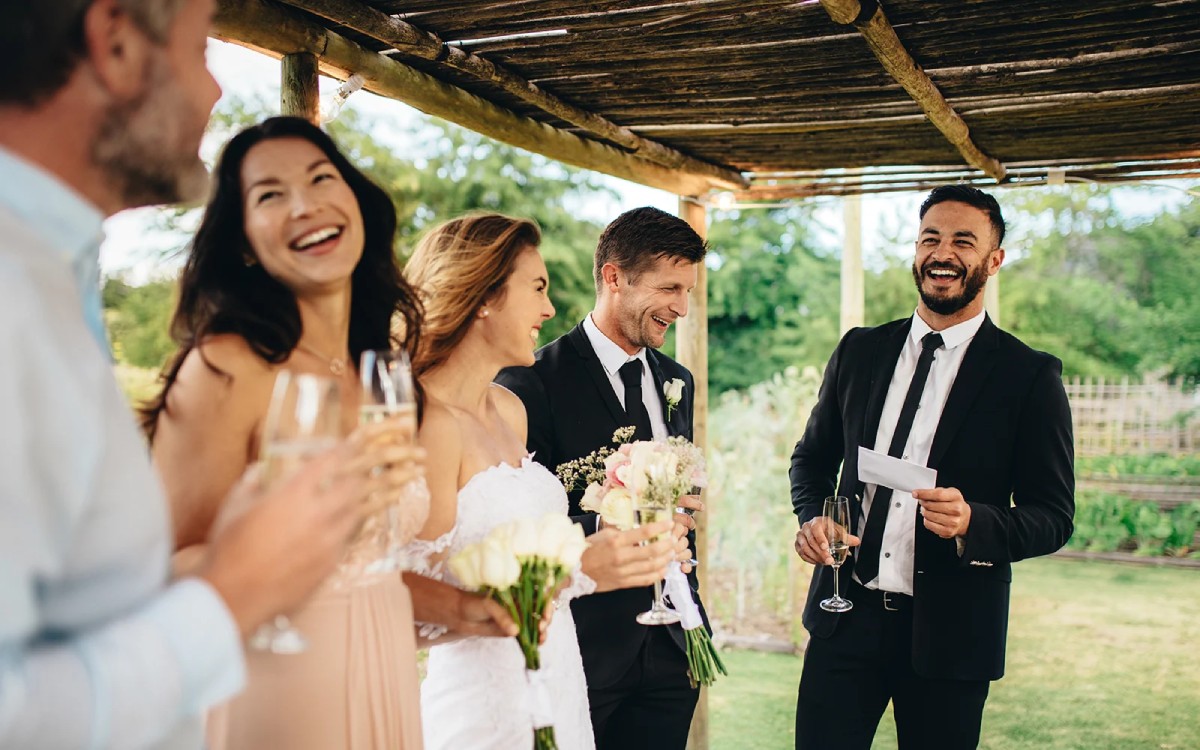
4. Animate the ceremony or reception
Witnesses are often asked to:
- give a speech,
- launch an animation or a surprise,
- coordinate the guests,
- ensure a good general atmosphere.
Their role is therefore essential to create a warm and fluid atmosphere.
FAQ – Wedding witnesses
- Can we have the same wedding witness for both spouses?
Yes, in most cases, it's possible. The law does not prohibit a single witness from signing for both partners, as long as the town hall accepts this configuration. However, it is recommended to check the local rules with the civil registrar. - How many witnesses are needed for a civil marriage?
Generally, you need at least one witness per spouse, or two witnesses in total. The law allows up to four witnesses, and some town halls may accept more. Witnesses must be present on the day and provide an ID. - Does a witness necessarily have to be a family member?
No. A wedding witness can be a friend, a family member, or any adult you trust. The important thing is that they are available, committed, and ready to accompany you through the different stages of the wedding. - Can we have multiple witnesses at a wedding?
Yes. Many couples choose to have multiple witnesses to distribute roles, include more loved ones, or balance family presences. It is also possible to distinguish between legal witnesses of the civil marriage and symbolic witnesses of a religious or secular ceremony.
Conclusion
Choosing a wedding witness is a deeply personal step. The law and traditions offer some flexibility: it is not mandatory to have a different witness for each spouse, and many couples today prefer to unite around the same trusted person. Whether you opt for a single witness or multiple witnesses, the key is to select people who support you, understand you, and sincerely share your joy.
Through their presence, their advice, and their symbolic role, witnesses help make the wedding more human, more intimate, and more memorable.
The important thing is to choose what best suits your couple, your story, and how you want to experience this unique moment.
Round Diamond Engagement Ring Promesse
- -15%
Cushion Diamond Solitaire Ma vie
- -15%
Half Alliance Round Classic Diamonds Promesse
- -15%
Traditional Round Diamond River Bracelet
- -15%
Black Diamond Stud Earrings
- -15%